
140W to 360W: The High-Wattage GaN Charger Arms Race (2026)
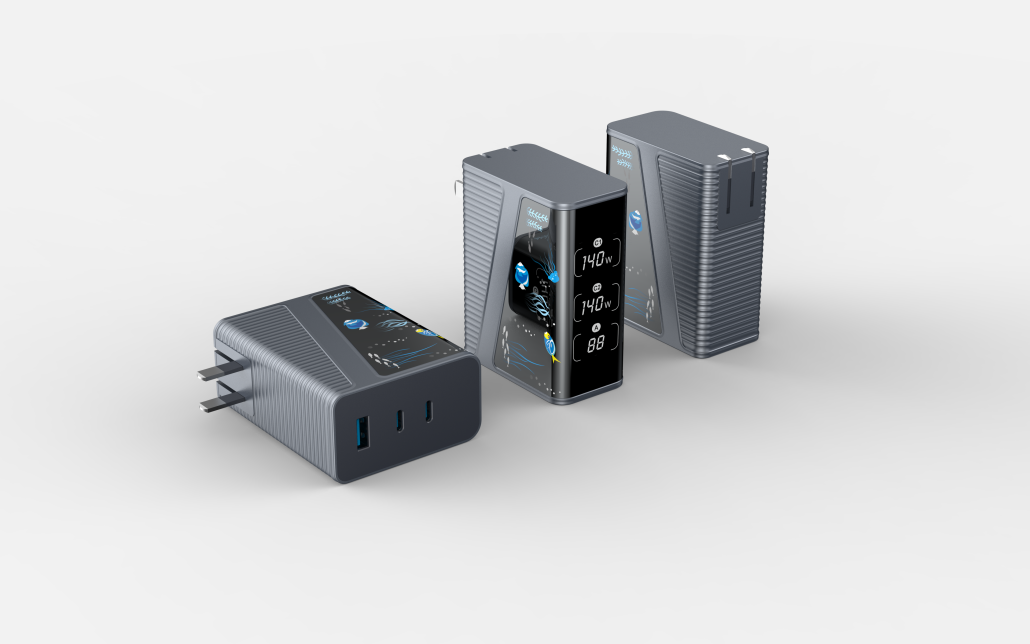
The High-Wattage GaN Charger : How 140W+ GaN Chargers Are Redefining Fast Charging in 2026
The days when a 30W charger was considered “fast” are long gone. Today, the battlefield for Gallium Nitride (GaN) chargers (High-Wattage GaN Charger) has shifted firmly into triple-digit territory. What started as a niche race to break the 100W barrier has now become a full-blown high-wattage “arms race”. In 2026, 140W is no longer a luxury — it’s the new baseline for flagship USB-C chargers. Meanwhile, leading brands are pushing the envelope to 240W and even a staggering 360W output, shrinking the gap between a pocketable wall charger and a desktop power station.
From 100W to 240W High-Wattage GaN Charger: Why More Wattage Matters
The driving force behind this trend is USB Power Delivery (PD) , specifically the PD3.1 and emerging PD3.2 specifications. These protocols introduce Extended Power Range (EPR) , officially supporting up to 240W over a single USB-C port. But the industry isn’t stopping there. With proprietary enhancements and multi-port designs, some devices now accept 240W or 360W total output — enough to simultaneously fast-charge a gaming laptop, a tablet, and two smartphones.
High power density is the secret sauce. Modern GaN III chips allow engineers to pack 140W of output into a chassis that’s smaller than many legacy 65W wall chargers. This compact size combined with cooler operation (thanks to thermal optimization and lower heat dissipation) makes these high-wattage adapters genuinely travel-friendly.
Multi-Port Chargers and Dynamic Power Allocation
With High-Wattage GaN Charger comes the challenge of sharing power intelligently. Nearly every flagship multi-port desktop charging station or travel charger now features Intelligent Power Negotiation and dynamic power allocation. For example, a 240W GaN charger with 4 USB-C ports can automatically prioritize 140W for a connected MacBook Pro while splitting the remaining 100W among other devices — without interrupting charging cycles. This power distribution is managed by real-time AI algorithms, ensuring faster charging speed without overloading any single port.
Real-World Examples: 240W and 360W Are Here
Several brands have already jumped past 140W. High-end models from Anker, UGREEN, and Belkin now routinely offer 240W total output, often with a mix of USB-C and USB-A ports. Niche players and crowdfunded projects have even demonstrated 360W prototypes — capable of juicing up an entire mobile creator rig (laptop, camera batteries, drone, and phone) from a single compact power adapter. While 360W is still rare, it signals where the market is heading: truly universal, single-cable charging for all personal electronics.
Safety and Certification Keep Pace
With such high power, safety is paramount. Reputable chargers carry 3C Certification (mandatory for the Chinese market) and include overcurrent / overvoltage protection as well as multiple temperature control sensors. Cooler operation from GaN technology directly contributes to safer high-wattage charging, reducing fire risk and prolonging battery lifespan of connected devices.
The Bottom Line: 140W+ Is the New Flagship Standard
Whether you’re a road warrior with a 140W-capable laptop or a tech enthusiast who wants to consolidate multiple chargers into one, the high-wattage GaN revolution is here. 140W is now table stakes; 240W offers true future-proofing; and 360W previews a world where one tiny USB-C PD charger can power everything. As PD3.2 rolls out and GaN efficiency improves further, expect even higher wattage in even smaller packages — without sacrificing thermal optimization or safety.

