
Difference Among PD/PPS/AVS
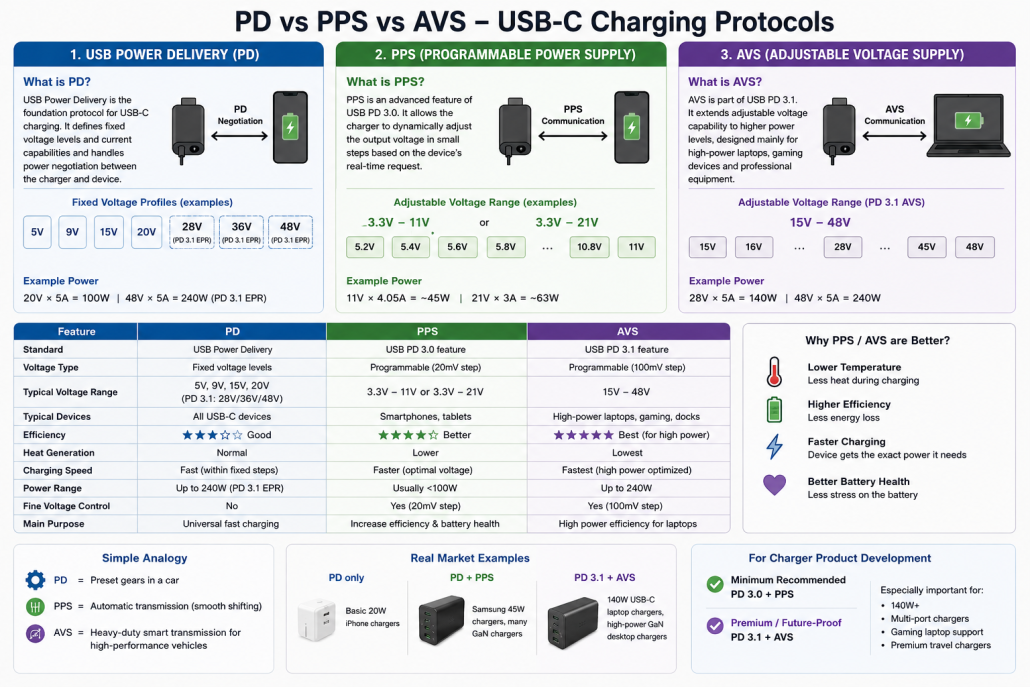
PD vs. PPS vs. AVS: What’s the Real Difference? (And Why It Matters for Your Next Charger Purchase)
I still remember the first time I looked at a USB-C charger and thought — wait, what does “PPS” actually mean? If you’ve ever found yourself staring at a wall of chargers, trying to decipher the alphabet soup of fast-charging acronyms, you’re not alone.
By now, most of us know that USB Power Delivery (PD) is the universal fast-charging standard behind our phones, tablets, and laptops. But in the last few years, two more terms have started appearing everywhere: PPS (Programmable Power Supply) and AVS (Adjustable Voltage Supply). Some chargers support one, some support all three, and the prices vary wildly.
So, what’s the actual difference? More importantly, which one do you actually need?
Let me break it down from someone who’s spent way too much time researching this.
📸 Infographic: The Evolution of USB PD Standards
Suggested image description: A timeline infographic showing the evolution from PD 2.0 (2014, 100W) → PD 3.0 (2017, 100W + PPS) → PD 3.1 (2021, 240W + AVS) → PD 3.2 (2025, SPR AVS mandatory above 27W). Each milestone should include the key feature introduced, with icons representing phones, laptops, and chargers.
The foundation: USB PD 2.0 arrived in 2014, followed by PD 3.0 in 2017, which introduced PPS and raised the ceiling to 100W. Then came PD 3.1 in 2021, pushing the limit all the way to 240W and adding AVS for high-power scenarios. Most recently, PD 3.2 brought AVS down to mainstream power levels — meaning the technology that once only mattered for high-end laptops now affects your smartphone charger too.
PD: The Universal Baseline — Why It’s Not Enough Anymore
USB Power Delivery is the foundation. It allows your charger and device to negotiate voltage and current dynamically, rather than just pumping out a fixed 5V. Standard PD offers preset voltage levels — typically 5V, 9V, 15V, and 20V — that your device can choose from. For iPhones, PD is all you need to trigger fast charging. For most laptops and tablets, PD works perfectly fine as a universal baseline.
But here’s where it gets interesting: standard PD is like a light switch with four preset positions — on or off at fixed levels. Your device might actually need 12V for optimal charging, but the closest PD option is 15V. The extra 3V gets converted to heat inside your phone or laptop, which slows charging and degrades battery health over time.
This is exactly why PPS and AVS were created: to close that gap between what the charger offers and what the device actually needs.
📸 Comparison Table: PD vs. PPS vs. AVS at a Glance
Suggested image description: A clean, professional comparison table with three columns (PD, PPS, AVS) and rows for Full Name, Introduced In, Voltage Adjustment, Step Size, Typical Voltage Range, Max Power, Best Suited For, and Key Limitation. Use brand-appropriate colors (blue for PD, green for PPS, orange for AVS) for visual clarity.
| Feature | PD (Power Delivery) | PPS (Programmable Power Supply) | AVS (Adjustable Voltage Supply) |
| Full Name | USB Power Delivery | Programmable Power Supply | Adjustable Voltage Supply |
| Introduced In | PD 2.0 (2014) | PD 3.0 (2017) | PD 3.1 EPR (2021) / PD 3.2 SPR (2025) |
| Voltage Adjustment | Fixed preset steps (5V, 9V, 15V, 20V) | Dynamic real-time micro-adjustments | Stable negotiated voltage with 100mV steps |
| Step Size | Large fixed intervals | 20mV (voltage) / 50mA (current) | 100mV |
| Typical Voltage Range | 5V–20V | 3.3V–21V | 9V–20V (SPR) / 15V–48V (EPR |
| Max Power | Up to 100W (PD 3.0) | Up to 100W (within SPR) | Up to 240W (EPR) |
| Best Suited For | iPhones, tablets, basic laptop charging | Samsung flagships, Android phones with direct-charge architecture | iPhones (17 series+), high-power laptops, future cross-platform devices |
| Key Limitation | Excess voltage converted to heat inside device | Extremely sensitive to cable quality and contact resistance; “power cliff” at low voltages | Not designed for real-time dynamic current adjustment like PPS |
| Heat Behavior | Moderate (heat generated in device) | Low (heat shifted to charger) | Lowest (stable output minimizes conversion loss) |
PPS: Android’s Secret Weapon
When Samsung advertises “Super Fast Charging” and your friend’s Android phone charges from 0 to 50% in 20 minutes, that’s PPS at work. Introduced with USB PD 3.0, PPS is a programmable protocol that lets the charger adjust voltage in tiny 20mV steps and current in 50mA steps — in real time, roughly every 10 seconds.
Why does this matter? Many Android phones use a direct-charge architecture (often called charge pump design), where the charger’s output goes almost directly to the battery with minimal voltage conversion inside the phone. PPS enables this by outputting a voltage that precisely matches what the battery needs at any given moment. The result: less heat inside the phone, faster charging speeds, and better overall efficiency. Samsung’s 45W charging, for instance, requires PPS — without it, you’ll get a much slower ~15W charge even with a high-wattage charger.
The Catch
PPS’s 20mV precision sounds impressive, but in real-world use, factors like cable resistance and connector quality can easily introduce deviations larger than 20mV, causing handshake failures or reduced performance. There’s also the “power cliff” problem: at lower voltages, current is capped, which means actual power output can drop significantly despite the charger’s nominal rating. PPS requires high-quality cables and well-matched hardware to deliver on its promise — which is why PPS compatibility remains somewhat fragmented across the Android ecosystem.
📸 Device Compatibility Visual Guide
Suggested image description: A visual guide showing popular device brands (Apple iPhone, Samsung Galaxy, Google Pixel, MacBook, Dell XPS) with labeled protocol requirements below each — e.g., “iPhone: PD (AVS for 17 series),” “Samsung: PD + PPS (required for 45W SFC),” “MacBook Pro: PD 3.1 EPR + AVS.” Use device silhouette icons for clean, recognizable representation.
Quick reference for device compatibility:
– iPhones (pre-17 series): PD is all you need — no PPS or AVS required
– iPhone 17 series: PD 3.2 SPR AVS for optimal 40W charging efficiency
– Samsung Galaxy flagships (S Series, Note): PD + PPS required for Super Fast Charging (45W)
– Google Pixel: PD with optional PPS support
– MacBook Pro / Air: PD 3.1 EPR with AVS for 140W+ charging
– Dell XPS / Lenovo ThinkPad: PD 3.1 EPR for full-speed 100W–240W charging
– iPad Pro: PD (standard) sufficient for 30W–45W charging
– Nintendo Switch: PD only — PPS and AVS not utilized
AVS: The New Standard Apple Is Betting On
If PPS is Android’s domain, AVS is where Apple is placing its bets. AVS (Adjustable Voltage Supply) first appeared in USB PD 3.1’s Extended Power Range (EPR) for high-wattage devices like laptops requiring up to 240W. It adjusts voltage in larger 100mV increments — five times coarser than PPS — over a much wider range, spanning 15V to 48V in EPR mode.
What changed the game was PD 3.2, which brought AVS down to the Standard Power Range (SPR) — meaning devices under 100W, including smartphones, can now benefit from adjustable voltage supply. In fact, PD 3.2 mandates that any product with power delivery capability exceeding 27W must support AVS mode. Apple’s iPhone 17 40W charger was the first to fully embrace SPR AVS, marking a deliberate shift in Apple’s fast-charging strategy.
Why coarser steps can actually be smarter: AVS takes a fundamentally different approach from PPS. Rather than chasing ultra-fine real-time adjustments, AVS negotiates a stable voltage once and maintains it — using constant current output that can deliver the full rated power across the entire supported voltage range.
This design eliminates PPS’s “power cliff” problem and makes AVS far less sensitive to cable quality and connector resistance. The result: AVS chargers can be simpler in design, lower in cost (some estimates suggest up to 25% cheaper to manufacture), and more reliable across different cable qualities. For Apple, AVS means a single protocol can serve everything from iPhones to MacBooks — reducing supply chain complexity while delivering consistent performance.
📸 PPS vs. AVS Design Philosophy Diagram
Suggested image description: A conceptual diagram comparing two design philosophies — on the left, “PPS: The Sculptor” showing fine, detailed voltage adjustments with 20mV precision for battery-level optimization; on the right, “AVS: The Architect” showing broader, stable voltage delivery at the system level across a wider range. Include annotations for “phone battery focus” vs. “system power focus.”
Think of it this way: PPS is a sculptor — constantly making tiny, precise adjustments to match the battery’s immediate needs. AVS is an architect — setting a stable, efficient voltage foundation that the entire device can rely on. Neither is inherently better; they solve different problems.
📸 Charger Compatibility Decision Flowchart
Suggested image description: A simple decision flowchart starting with “What device(s) do you need to charge?” branching to different outcomes: “iPhone only → PD charger (20W–40W),” “Samsung flagship → PD + PPS charger (25W–45W),” “iPhone 17 + future devices → PD 3.2 + AVS charger,” “Multiple devices (iPhone + Samsung + laptop) → Multi-protocol charger (PD + PPS + AVS, 65W–100W).” Use clear arrows and icon-based decision points.
Practical charger recommendations by use case:
– iPhone user (pre-17 series): A standard 20W–30W PD charger is perfectly sufficient
– Samsung flagship user: Look specifically for a charger with PPS support (25W–45W) to unlock Super Fast Charging
– iPhone 17 series user: A PD 3.2 charger with SPR AVS support will deliver the best efficiency
– Multi-device household: Invest in a 65W–100W GaN charger that supports PD + PPS + AVS — this covers iPhones, Samsung flagships, MacBooks, and most USB-C laptops with a single adapter
The Bottom Line: PD Is the Foundation, PPS Is the Present, AVS Is the Future
Here’s how I’d summarize it:
– PD is the universal standard — every USB-C device supports it. It works reliably for iPhones and basic laptop charging, but its fixed voltage steps create inefficiency and heat.
– PPS is Android’s performance booster — essential for Samsung Super Fast Charging and optimized for direct-charge phone architectures, though it demands quality cables and careful hardware matching.
– AVS is where the industry is heading — with Apple leading adoption and PD 3.2 making it mandatory above 27W, AVS will gradually become the default across both phones and laptops, offering stable, efficient power delivery with broader compatibility.
If you’re buying a charger today, look for one that supports PD + PPS as a minimum. If you want to future-proof, go for a multi-protocol charger that includes AVS — especially if you’re in the Apple ecosystem or plan to be.
The USB-C dream of one charger for everything is getting closer. Understanding these three letters — PD, PPS, AVS — is the key to making it happen.
—
What’s your go-to fast charging setup? Have you noticed a difference between PD-only and PPS chargers on your Samsung device? Or are you already using an AVS charger with the iPhone 17? Share your experience in the comments — I’d love to hear what’s working (and what’s not) in the real world.
#FastCharging #USBC #PowerDelivery #TechExplained #ChargerGuide #Apple #Samsung #GaNCharger
