We’ve all been there. You reach for a charger, plug in your phone, and nothing happens. Or worse, it starts charging — but at a painfully slow trickle. The reason? Your charger and your device speak different “fast-charging languages.”
For years, the consumer electronics industry has been plagued by a frustrating reality: proprietary fast-charging protocols that refuse to talk to each other. Huawei’s SuperCharge, OPPO’s VOOC, Qualcomm’s Quick Charge, USB Power Delivery — each works brilliantly within its own ecosystem, but cross a brand boundary and you’re back to 5W limbo.
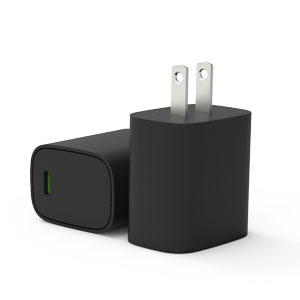
This is the problem that UFCS (Universal Fast Charging Specification) and GaN (Gallium Nitride) technology are solving together. And the 100W GaN charger powered by UFCS is emerging as the definitive answer.
Let me break down why this matters.
—
What Is UFCS? The “Universal Translator” for Fast Charging
UFCS stands for Universal Fast Charging Specification — a unified fast-charging standard spearheaded by the China Academy of Information and Communications Technology (CAICT), jointly developed with major players including Huawei, OPPO, vivo, and Honor . Think of it as the “universal translator” that finally gets different brands’ charging protocols speaking the same language.
The protocol incorporates advanced, safety-oriented technologies such as real-time impedance detection, encrypted authentication, and adaptive power adjustment, enabling seamless cross-brand, cross-device fast charging compatibility . In practical terms, this means one charger can fast-charge your Huawei phone, your OPPO tablet, your vivo earbuds, and your MacBook — all at optimal speeds.
Since its inception, UFCS has undergone a remarkable standards progression: from industry group standard to national industry standard, and finally — in a landmark achievement — to international standard. In late 2025, the International Telecommunication Union (ITU-T) officially published the *Universal Fast Charging Solution for Mobile Terminals* (Standard L.1004), with UFCS adopted as the sole best-practice case within the standard . This marks the first time the ITU has issued a universal fast-charging standard, and China’s independently developed UFCS protocol sits at its core.
As of mid-2025, over 221 products had received UFCS certification, spanning 59 smartphones, 9 tablets, 88 chargers, 54 chipsets, and more across 42 companies . By 2026, UFCS has entered its 2.0+ phase, establishing a 40W baseline for authentication-free cross-brand compatibility and being incorporated into China’s mandatory national safety standard for power banks (GB 47372-2026) .
—
Enter GaN: The Semiconductor That Changes Everything
If UFCS is the “brain” of the new charging ecosystem, Gallium Nitride (GaN) is the muscle.
Traditional silicon-based chargers hit a hard wall at high power levels: they run hot, they’re bulky, and their efficiency drops under load. GaN, a wide-bandgap semiconductor, changes the physics. Compared to legacy silicon designs, GaN delivers up to 40% smaller form factors, approximately 3× higher switching frequencies, and efficiency ratings exceeding 95% at full load. A 100W GaN charger can be as small as a traditional 30W silicon brick, while generating significantly less heat.
This isn’t niche anymore. By Q1 2026, 82% of chargers rated 65W and above on the market had adopted GaN technology, up from just 27% in 2022. The global GaN chargers market was valued at approximately US$1.2 billion in 2026, projected to reach US$6.0 billion by 2033 at a remarkable CAGR of 25.7%. And the 100W segment is the fastest-growing power category, driven by demand for laptop and multi-device charging solutions.
—
100W GaN + UFCS: Why This Combination Is the Sweet Spot
Bringing 100W GaN technology and UFCS together creates something genuinely compelling. Here’s what makes this combination so powerful:
- True Cross-Brand Universal Charging
With UFCS 2.0’s 40W authentication-free baseline, a single 100W GaN charger intelligently negotiates the optimal charging protocol — whether it’s UFCS, USB-PD 3.1, or legacy protocols — and delivers the right power to every connected device. No more “charger roulette” when you borrow a cable from a colleague.
- One Charger for Your Entire Tech Stack
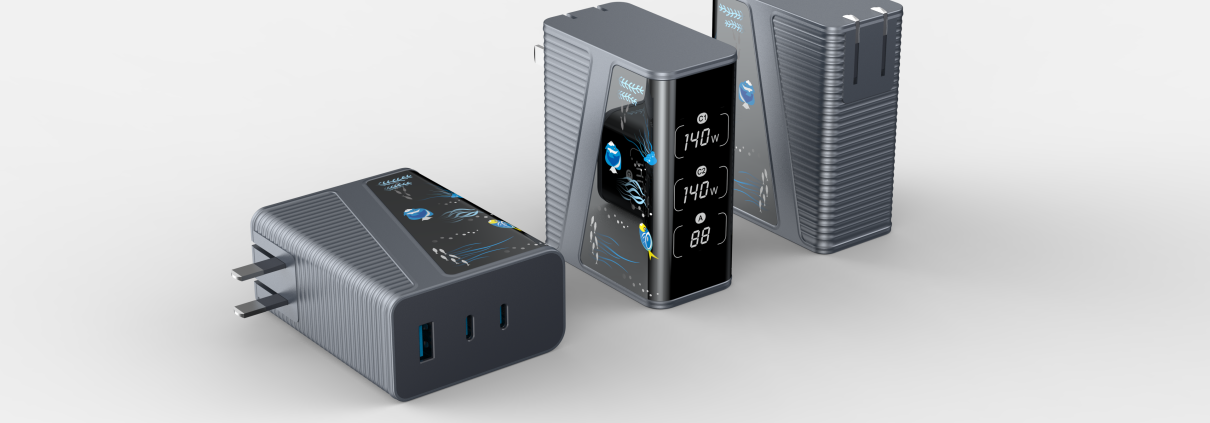
A 100W GaN charger can simultaneously power a laptop at 65W, fast-charge a phone at 30W, and trickle-charge earbuds — all from a single device. This aligns with the industry’s shift from “single-device fast charging” to “full-scenario energy management”.
- Compact, Cool, and Travel-Ready
Thanks to GaN, 100W chargers are now pocket-sized and travel-friendly. The technology enables power densities that were unthinkable just a few years ago.
- Future-Proof Investment
UFCS is actively expanding beyond smartphones. The protocol roadmap targets 240W to 3600W power segments for robotics, drones, and industrial equipment. The UFCS ecosystem is also extending into wireless charging with the WUFCS 1.0 group standard already released. A 100W UFCS charger purchased today is designed to serve tomorrow’s device landscape.
—
Real Products Leading the Charge
Several flagship products already demonstrate what 100W GaN + UFCS looks like in practice:
– Huawei 100W All-in-One GaN Charger: Supports UFCS 1.2 and delivers up to 100W total output across multiple ports. It also supports Huawei’s 40W冰糖 (SuperCharge) and 66W 卡片全能充 (Card All-in-One) variants, covering a range of UFCS-certified devices.
– OPPO 100W “Little Square Bottle” GaN Charger: A UFCS-certified compact charger leveraging GaN technology, designed to fast-charge OPPO, OnePlus, and other UFCS-compatible devices seamlessly.
– Huawei Pura 90 Series and Mate 80 Series: Among the flagship phones that support UFCS fast charging at elevated power levels, with some Huawei tablets supporting UFCS up to 100W.
– OnePlus Ace 5 Ultimate Edition: Features a 6,700mAh battery with 100W Super Flash Charging and UFCS compatibility, demonstrating how flagship phones are converging on universal fast-charging standards.
– Meituan Shared Power Banks: In a surprising industry move, Meituan’s next-generation shared power banks have adopted UFCS 1.0, delivering up to 27.5W peak power — well above the traditional 10-15W shared power bank standard.
The broader UFCS ecosystem now covers the complete “chip-to-charger-to-device-to-certification” value chain, with leading chip manufacturers like Southchip, Injoinic, and Richteck all producing UFCS-compatible GaN power ICs.
—
Why This Matters for the Industry
The convergence of UFCS and GaN at the 100W level addresses three massive pain points simultaneously:
For consumers: No more carrying different chargers for different devices. One compact 100W GaN charger covers everything. As the industry coalition behind UFCS emphasizes, the universal standard significantly reduces electronic waste and aligns with global sustainability goals.
For brands: UFCS provides a standardized, internationally recognized certification framework that builds consumer trust. The ITU-T L.1004 adoption gives UFCS global legitimacy, making it easier for brands to market chargers worldwide without navigating fragmented regional standards.
For the planet: Fewer chargers needed per household means less e-waste. The ITU-T’s adoption of UFCS explicitly cited environmental sustainability as a core motivation for the universal standard.
—
The 100W GaN charger powered by UFCS isn’t just another gadget — it represents a fundamental shift toward a truly universal charging ecosystem. A Chinese innovation that has become a global standard, UFCS demonstrates what happens when major industry players collaborate rather than compete on charging protocols.
If you’re in the consumer electronics space — whether designing products, sourcing accessories, or building retail assortments — GaN + UFCS at the 100W tier deserves your attention. It’s where the technology, market momentum, and regulatory push are all converging.
The era of “one charger, all devices, maximum speed” is no longer a future vision. It’s here. And it fits in your pocket.
—
What’s your experience with multi-device charging setups? Have you tried GaN chargers yet? I’d love to hear your thoughts in the comments.
—
UFCS GaN FastCharging USBPD UniversalCharging TechTrends ConsumerElectronics Sustainability ChargerTechnology 100WCharger Innovation GreenTech